10 Best 3D Websites Examples of 2026 Ranked and Reviewed

Updated: Jun 14
The best 3D websites are not always the loudest ones. I look at 3D the same way I look at every other website design decision, which is by asking: does it actually helps the business or is it just there to be impressive ? Because honestly, a lot of viral 3D websites are wow demos. They look beautiful. They convert nothing. They lag on mobile.

Some of these earned the top spots because the 3D is doing real work. Some are here because the craft is so good they are worth studying even if you would not copy the strategy. I will tell you which is which.
How We Ranked and Reviewed the Best 3D Website Designs of 2026
Visual Impact and Originality
You can tell within five seconds if a 3D site has its own voice or if it is borrowing one. Originality matters because the whole point of going through the effort of 3D is to be unforgettable. If your 3D site looks like every other 3D site, you spent the budget for nothing.
Performance and Load Speed
This is where most 3D sites die quietly. A site can look like a film, but if it takes 8 seconds to render the hero on a mid-range Android phone, you have already lost half the audience. I weighted this heavily because real-world performance is the difference between a portfolio piece and a business asset.
Mobile Experience
Roughly 60 percent of web traffic is mobile and a lot of 3D sites either break on phones or serve a watered-down version with no warning. I checked each site on an iPhone and on Android, and I dropped sites in the ranking when the mobile experience felt like an afterthought.
Purpose and Conversion Value
Is the 3D doing a job? Is it helping the visitor understand a product, feel a brand, or take an action? Or is it just there because someone wanted to flex? Some of the most technically impressive 3D sites on the internet are also some of the worst at moving people toward a decision. I kept that front of mind.
Technical Craft
Shaders, lighting, transitions, the way scrolling links to motion. This is the stuff that separates a quick Spline embed from a piece of work that took someone six months to build. Both can be valid, but the craft tier matters when we are talking about "the best."
The 10 Best 3D Website Design Examples
These are ranked, and the order is mine. You might disagree with where I placed something. That is fine. The point is to actually have a position instead of dumping ten sites in a row and calling it a list.
1. Igloo Inc: the corporate landing page that doesn't feel like one
Site: igloo.inc

Igloo Inc is the first one I want you to study because it does not look like a corporate parent page at all. You scroll through a frozen 3D landscape, the camera drifts slowly, every portfolio project sits inside its own block of ice, and chromatic aberration softens the edges in a way that makes the whole thing feel cinematic. The intro sequence sits somewhere between a sci-fi title card and a luxury watch ad. The reason it earns the top spot is signal. A corporate parent page that took itself this seriously, is telling investors, partners, and anyone watching that the brand has weight.
If your company has gravity, your website should show it.
2. Iris K: musician website design as a music museum
Site: https://theirisk.com/

Iris K is a Berklee-trained composer, violinist, and pianist, and her personal site is built like a music museum. You press a button to break the silence, the site literally tells you to put on headphones, and what unfolds is a scroll-driven immersive 3D experience where the music and the visuals move together. Loading screen, back/next navigation, mute toggle, the whole thing. This is what happens when an artist treats their portfolio as part of the work instead of a press kit. If you sell anything where the experience of consuming it matters, this is the model.
The medium does not just carry the message. The medium is the message.
3. Demilie Creamed Honey: e-Commerce website
Site: demilie.ru
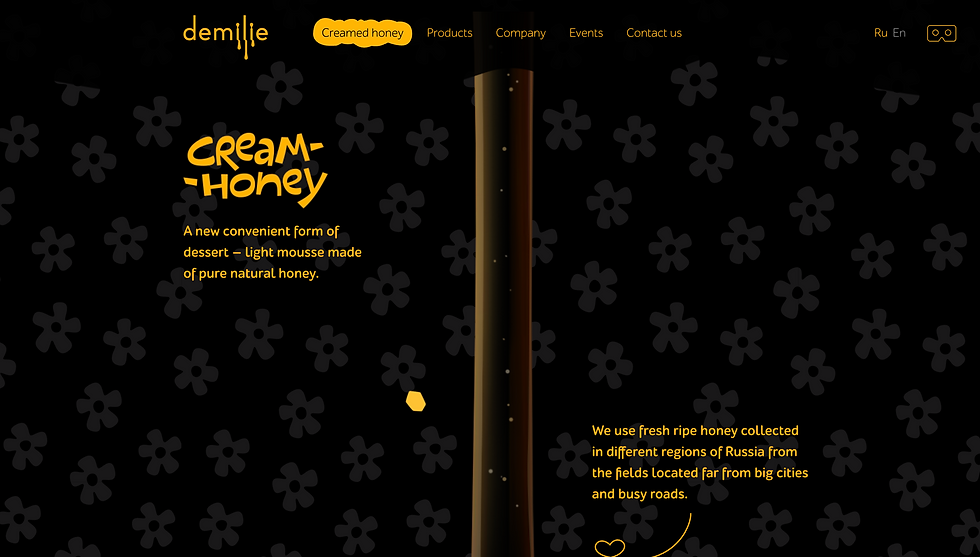
A small CPG brand selling creamed honey, and the 3D website walks you through the entire creaming process as you scroll. Bees, comb, harvest, churn, jar. By the time you reach the buy button, you understand the product better than you would after a two-minute brand video. This is one of my favorite use cases for 3D on an ecommerce site, because the 3D is doing real work. It is educating the buyer. For any product with a complex value chain, like specialty food, craft manufacturing, or sustainable materials, building the explanation into the scroll is more effective than burying it in an "About" page no one reads.
4. Star Atlas: full-immersion world-building
Site: staratlas.com

Star Atlas is a Web3 gaming franchise, and the site is basically a playable solar system. You explore planet by planet, and each one opens up a different piece of the game's lore. It is the most fully immersive site on this list, and honestly it is closer to an interactive 3D film than a traditional website. Whether or not you care about gaming, the signal the site sends is what matters here.
This brand is willing to commit. Premium buyers, partners, and investors all want to see that signal in whoever they work with.
5. Chrome Tattoo: when a small business commits
Site: chrometattooparis.com

A specialized sci-fi tattoo studio in Paris that made one of the most committed small business websites I have ever seen. The hero is a chrome humanoid head that rotates 360 degrees following your cursor. The background lines redraw based on your mouse position. Every transition, every page, every cursor state stays in character. There is no point on the site where they break the world they built. For a niche small business, that level of commitment is more valuable than ten testimonials, because it tells the buyer "this person knows exactly who they are."
Specificity reads as confidence, and confidence is what people pay a premium for.
6. Scout Motors: premium motion as corporate confidence
Site: scoutmotors.com

Scout is the Volkswagen-owned American EV brand bringing back a 1960s nameplate, and they put $2 billion into a South Carolina factory to do it. The site matches the scale of the bet. Heavy hero animation, smooth 3D transitions between truck models, a configurator that lets you walk around the vehicle in real time.
The visual language is more than just "tech startup," it is "American industry, on the way back." That choice is the lesson here.
7. iyO: AI hardware website design for the post-screen era
Site: https://www.iyo.ai/

iyO makes agentic computers you can talk to instead of screens you have to touch. The site is built to sell that vision before it sells the product. This is the playbook for any company launching premium hardware in 2026.
If your product is asking customers to rethink how they do something, the site has to make them feel the future before they ever read a spec sheet.
Apple set this bar fifteen years ago. iyO is one of the few brands actually meeting it.
8. Robin Payot: a portfolio that is the proof
Site: robinpayot.com

Robin Payot is a Paris-based freelance 3D modeler who builds 3D websites for brands, and his own portfolio is, fittingly, the full demonstration. Every section is interactive 3D. The cursor moves objects in space. The entire site is a single immersive scroll, no pages, no breaks. There is no version of this site that would not get him hired. This is the rare case where the medium is the message.
If you specialize in any premium visual craft, like photography, 3D, or art direction, your portfolio should embody the craft, not describe it.
9. Harmony: festival website design as an immersive entrance
Site: https://harmony.now/

Harmony is a deep-listening music festival in Amsterdam, and the site is designed as the entrance to the experience rather than a page about it. You "enter the world of Harmony," you can listen to ambient pieces named after elements like Sky, Water, Wind, and Earth, and the entire site is designed to be felt before it is understood. There is even a rotate-screen prompt because the immersive experience is built for landscape.
The brief is not "make a website for our event" but "make the audience start feeling our event from the second they land."
10. SOM: wellness brand website design as a ritual
Site: https://www.drinksom.eu/
SOM is a functional daily elixir launching in 2026, built around the ancient SOMA myth and positioned for the modern human chasing mental focus and physical stamina. The site is one of the more committed brand worlds you will see this year. Loading screen sets the tone, animated counters reveal the brand vocabulary, the elixir bottle becomes the center of a small world the visitor walks through before they ever get to a buy button. The lesson here is the same as Demilie, but at a different tier.
If you are launching a premium CPG product, the website is not a brochure. The website is the first sip of the brand.
When a 3D Website Is Worth It and When It Is Overkill
This is the part where I tell you the truth most articles will not. 3D is not always the answer. Sometimes it is the wrong tool. Here is how I decide.
3D is worth it when:
You are selling a physical product the customer would naturally want to inspect, like shoes, furniture, cars, or watches.
Your brand identity depends on standing out visually, like a creative agency, a luxury brand, or a launch campaign.
You are building a portfolio or showcase where the medium is part of the message.
The 3D directly supports understanding, like architecture, scientific visualisations, or product configurators.
3D is overkill when:
The site's main job is to capture leads or bookings as quickly as possible.
You are working with a tight budget and a tight timeline.
Your audience is largely on slow connections, older phones, or in regions with patchy data.
A clean, fast-loading 2D site would convert better, which honestly is most local businesses.
If you fall into the second list, the right call is not "no design." The right call is sharp design, strong copy, and the kind of micro-interactions that make the site feel premium without making it heavy. That is what I build for most of my clients, and it is what converts.
What Makes a 3D Website Actually Work
Across about 100 websites builds I have shipped, the sites that converted best were not the ones with the most visual fireworks. They were the ones where every visual choice, including any 3D or motion, was serving a job.
A 3D website actually works when:
The 3D has a job. It explains something a flat image cannot, it makes a product feel real, or it tells a story scrolling cannot tell on its own. If you can answer "what would we lose if we removed this" with "nothing," remove it.
The performance is good. Lazy-loaded assets, compressed textures, fallback images for slow connections, and a hard look at the mobile experience.
The user pathways are still clear. The CTA is still visible. The navigation still works. The 3D never gets in the way of what the visitor came to do.
Mobile is treated as the default, not the version you build last. Either the 3D scales gracefully on phones, or there is a thoughtful alternative experience for smaller devices.
Clients who came to me for redesigns saw their conversion rates climb an average of 250% after we rebuilt their sites around clarity and speed first, with visual impact second. That is the order. Get the foundation right, then decide how much 3D the site can afford.
Can You Build a 3D Website on Wix?
Short answer, yes. You can absolutely have a 3D website on Wix, and honestly for most small businesses, Wix is a smarter starting point than chasing a custom build. The platform has matured a lot, the speed is solid when the site is built properly, and the options below give you 95 percent of the visual punch without the agency invoice.
Spline Embeds on Wix
Spline lets you build a 3D scene in their browser editor, then gives you an embed code you can drop into Wix using the HTML iframe element. Interactive, rotates with the mouse, looks expensive. Takes a day, sometimes less.
Lottie Animations and Video Loops
Wix supports Lottie natively, which means you can drop in vector animations that give the page motion and depth without loading any 3D models. Combined with a short looping video in the hero, you can produce something that feels alive without hurting your load speed.
Custom Code with Velo
For clients who want something more bespoke, Velo lets you write actual JavaScript inside Wix. You can integrate Three.js elements directly if the project calls for it. This is the route I take when a client has a specific custom 3D moment they want to nail.
Lightweight 3D Hero Sections
The simplest path is a pre-rendered 3D video loop or scroll-triggered animation, dropped into the hero. The illusion of 3D, the feel of motion, none of the build cost. For local businesses, this is almost always the right answer.
If you want a Wix site that feels premium without dragging on speed or budget, this is the lane I live in. WixFresh handles all four of the options above, and I will tell you honestly which one your business actually needs.
Build a 3D Website That Actually Converts
Here is what I want you to take from this.
The best 3D website designs of 2026 are not the loudest ones. They are the ones where every visual choice is doing a job.
That is the entire game. You do not need a massive budget, a dev team, or a six-month timeline to ship a site that feels premium and actually moves your business forward. You need the right strategy and the right level of visual impact for what you are selling.
That is what I do at WixFresh. Clean, conversion-focused Wix websites that can integrate the right amount of 3D, motion, or design polish for your business, your audience, and your budget.
If you are ready to upgrade your site to something that actually competes with the big brands in your space, let's talk.
How Much a 3D Website Costs and How Long It Takes to Build
A simple embed in an existing site is a few days of work. Low cost, mostly the designer's time, and the result is one or two interactive elements that lift the page without rebuilding it.
A custom 3D website designg with bespoke shaders, scroll-driven interactions, and proper performance is weeks to months. It needs a developer who actually does this for a living, not a generalist. The cost reflects that.
Agency-level immersive sites are real investments. These are projects with team budgets, not freelancer budgets, and they tend to be reserved for brand-defining moments like product launches or major rebrands.
For most small businesses, the right move is somewhere in the middle and closer to the cheap end. A handful of well-placed micro-interactions, a single 3D element on the hero, or a clean motion-driven scroll experience will get you 80 percent of the impact at a fraction of the budget. I have shipped sites like this for clients who would never have justified a full custom build, and they outperformed the heavier competitors in their space because they actually loaded.
Common 3D Website Mistakes to Avoid
I have seen these on real client sites, not just bad portfolio demos. These are the patterns that quietly burn budget and bounce visitors.
Heavy Load Times That Kill Conversions
A 3D hero that takes 8 seconds to load on a mid-tier phone is a 3D hero almost nobody sees. Visitors leave before your masterpiece even renders. Compress textures, lazy-load assets, and test on real devices, not just your laptop.
3D Without a Clear Purpose
This is the most common one. Someone adds a rotating 3D logo or a floating geometric shape because it looks modern. It does not help the user understand anything. It does not support the buying decision. It is just there. Cut it.
Broken Mobile Experiences
A 3D site that runs super smooth on desktop and crashes Safari on an iPhone 12 is not a finished site. Mobile is where most of your traffic actually is. If 3D cannot work on a phone, design a clean fallback. Do not just hope.
Confusing Navigation and Scroll Behavior
Some 3D sites hijack the scroll, freeze the page, or rewire the back button. Cool for an art installation. Bad for a business. Users should always know how to get to your contact page.
Ignoring Accessibility
Animations that can trigger seizures, text baked into 3D models that screen readers cannot reach. Accessibility is not optional. It is a legal issue in some countries and a competence issue everywhere else.
Frequently Asked Questions About 3D Websites
Are 3D websites good for small businesses?
They can be, if the 3D serves a clear purpose like showcasing a product. But for most small businesses, clean design, fast load times, and sharp copy will outperform a flashy 3D site. Get the foundation right first, then add visual impact where it earns its place.
Do 3D websites work on older browsers and devices?
Modern browsers all support WebGL, which is what most 3D sites are built on. Older devices may struggle with performance, so any serious 3D build should include a fallback experience for users whose devices cannot handle the full version. If a site does not have a fallback, that is a sign it was not built for the real world.
Can I add 3D elements to my existing website without rebuilding it?
Yes, and this is what I recommend for most clients who already have a site they like. Spline embeds, Lottie animations, and video loops can all be added to specific sections of a live site without touching the rest of it. You get the visual upgrade without paying for a full redesign.
How do I optimize a 3D website for Speed?
Compress your textures aggressively, lazy-load 3D assets so they only render once the page has loaded the core content, and use lightweight placeholder images during loading so the page does not jump around.
Related reading on WixFresh:
16 Best Luxury Websites of 2026. Companion piece, more focused on visual restraint and material design
20 Inspiring Consulting Website Examples. Closer to the B2B case study I walked through above
Best Animation Websites of 2026. For when motion is the centerpiece rather than the accent
Best Infinite Scroll Websites. Single-page experiences with editorial pacing
Our services for service businesses. What we do, how we work, what it costs